How to support someone healing from trauma: Dr Mahima Sahi

Dr Mahima Sahi on what trauma recovery looks like, why you can’t love someone out of trauma, and how to offer safety without shame.

Riddhi Jadhav
Words by Riddhi Jadhav

Published November 2, 2026 · 5 min read

How to support someone healing from trauma: Dr Mahima Sahi

Trauma leaves a mark long after an experience has passed. We explored in the previous interview with Dr Mahima Sahi that the effects of a traumatic incident reach beyond the memory of what happened, affecting a person’s sense of self. It raises equally important questions: what does it take to heal from it? 


Recovery does not mean putting the past behind us. Psychiatrist Judith Herman, in her influential work Trauma and Recovery, proposed three stages of recovery: establishing safety, remembering what happened, and reconnecting with life and relationships. So healing involves rebuilding a sense of control, stability, and connection to the present. Although similar, the path is never so straightforward for all trauma care patients. 


What does the road to recovery look like in a therapy room? How does a psychologist help, and how can caregivers around ensure the same? Answers to this and more from Dr Sahi, whose work involves clinical quality, supervision, and training other therapists in the field of trauma care. 


You specialize in trauma work, and for many of us, healing from trauma is lifeline. But what does progress in therapy look like for trauma patients? How does it impact the way someone treats themselves or navigates relationships? 


Progress in trauma therapy does not focus on making someone completely unaffected by what happened to them. It works quietly, and progress starts when a person slowly learns to stop organizing their entire life around that incident. 


The improvement reflects in smaller everyday actions like saying no without feeling guilty or asking for help without feeling weak.


People are okay with making mistakes and getting comfortable with uncertainty without desperately trying to predict what happens next. 


In relationships, progress can look like recognizing that familiarity isn't necessarily safety. It is when a person notices something doesn’t feel right and begins to trust their own judgment again. They learn to stay in a relationship that feels safe while also tolerating the vulnerability that shows up when someone starts caring for them. 


And how does it shape up in one’s relationship with oneself, since we also spoke about how it gets impacted? 


In recovery, one’s relationship and perception of themselves change slowly too. There is less punishment and shame. The person learns not to measure their worth by their achievements or their usefulness by how much others need them. 


Ultimately, trauma therapy is never about erasing the past but rather helping someone reclaim enough safety and agency in the present so that the past no longer gets to make all of their decisions for them.


Understood. So far, we have spoken about what it is to manage trauma. But there’s another side to this - and that is how trauma affects those around you. You may love them with all your heart, but how do we establish strong relationships despite trauma?


The first thing to understand is that you cannot love someone out of their trauma, and this is difficult to accept when you care deeply about someone. 


People need to learn to ask instead of assume. “Do you want me to listen, help you think through this, or just sit with you?” A small question like this can be incredibly powerful.

We should remember that a post-trauma patient is not what happened to them; they are a still a whole person, with humor, preferences, anger, ambition, sexuality, ordinary good and bad days. A loved one’s job is not to rescue them from every difficult feeling. Just help by creating enough safe space that, over time, they learn that they don’t have to face those feelings alone. 


How does one create this safe space when there is still a societal shame around experiencing any kind of trauma? 

Shame thrives in silence, and one of the first ways we create safety for someone who has gone through a traumatic experience is by not making them defend the legitimacy of their pain. We are too comfortable asking, “What happened?” but much less comfortable framing something as, “What did that experience do to you?”

For example, a bad divorce may involve grief, rejection, betrayal, financial uncertainty, loss of identity, disruption of their family system, etc. If someone carries the internal belief that “I failed,” “I wasn't enough,” “I should have seen this coming,” and people around them reinforce it through questions, comparisons, or judgment, the person may confuse what happened to them with who they are.

So creating a safe space begins with separating the event from the identity. Instead of “Why couldn't you make the marriage work?” we should ask, “How are you doing with everything that has changed?” Instead of rushing to reassure them, “You'll find someone else”, allow them to grieve what they actually lost. 

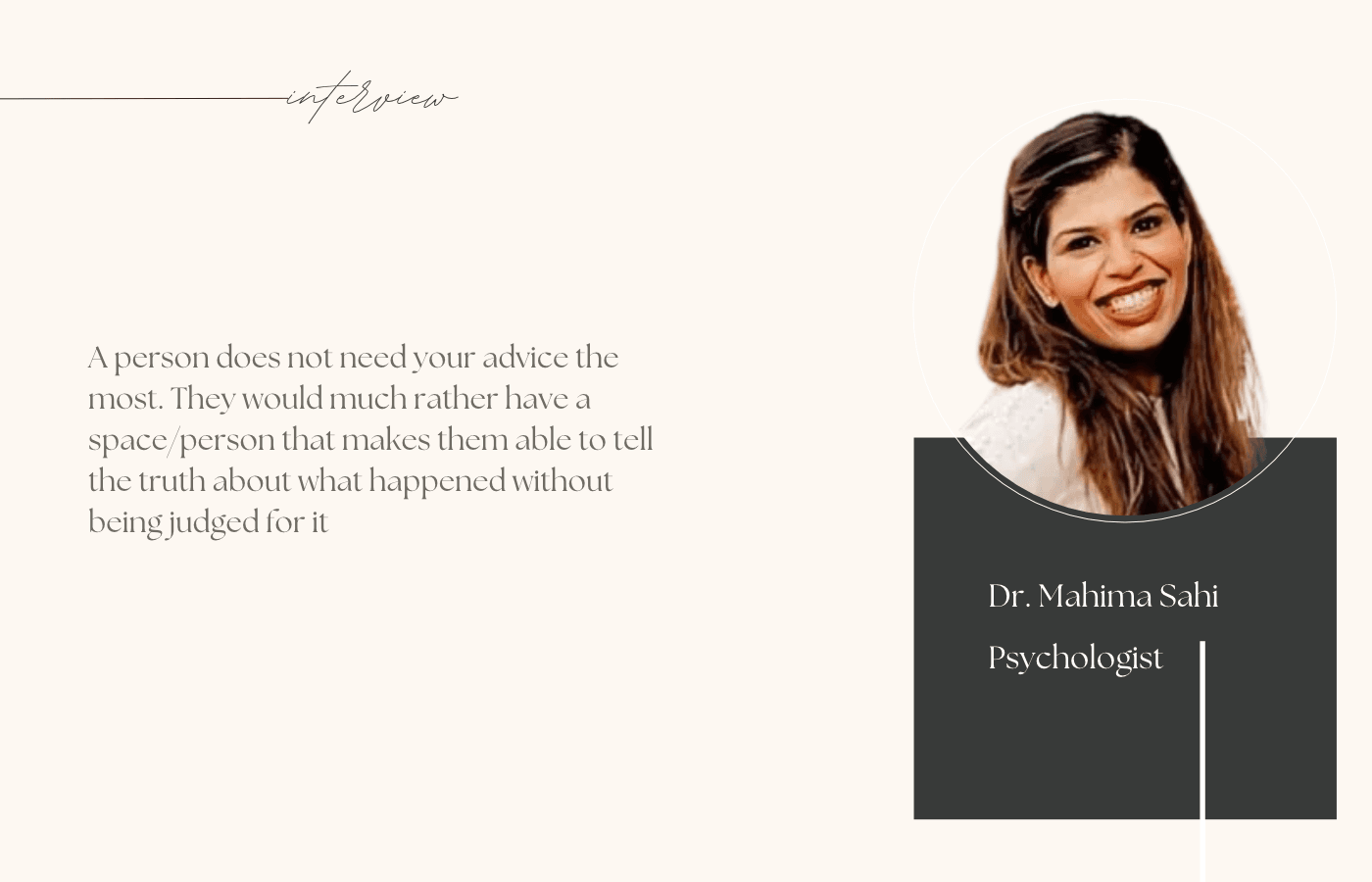
A person does not need your advice the most. They would much rather have a space/person that makes them able to tell the truth about what happened without being judged for it. 

These are some terrific, insightful answers, Dr. Mahima. In closing, I would love to know if there are misconceptions around trauma that you want to change? 

A misconception I’d like out of the way: trauma is defined by what happened to you. 

We spend a lot of time asking the wrong questions: “Was the event bad enough?” instead of “What did this experience do to your sense of safety? What did you have to become in order to survive it? And what is it still asking you to do today?”

A traumatic situation doesn’t always look dramatic or like someone is falling apart. On the contrary, it can be like being exceptionally successful, never needing anyone, handling everything yourself while feeling completely exhausted internally.

Someone may have everything they once thought would make them happy, but not feel any warmth in it. We should not romanticize these adaptations or remain stuck in them. 

With enough compassion, a person develops new choices; it is eventual, but it happens. Healing gives us back a choice to realize that what once kept us safe doesn’t have to keep running our life. 


You can find Part I of the interview here.


Continue the Healing

Stories like this one helped 23 Indians share their truth.

Read the MyndStories Anthology — first-person essays on anxiety, grief, identity, and the slow work of healing.

Get the BookFind a Therapist

The MyndStories Collection

Our physical imprint on the digital landscape. Curated for the slow, thoughtful reader.

View All Products
Our Stories Are Us — MyndStories Anthology
Our Anthology

Our Stories Are Us

23 Indians share their mental health journeys in essays that heal. Bound in a book that matters.

Order Your Copy
MyndReaders

Book Club

Expand your horizons with monthly curations of literature that challenges and heals. Join a community that reads with intention.

Join the Book Club
Book Club Selection 1
Book Club Selection 2

Continue the Journey

Weekly Curations

Join 15,000+ readers who receive our Sunday morning editorial on mental health, literature, and living well.

We value your peace. No spam, just stories.