The classroom is quiet except for the shuffle of small feet. Children crouch low, shoulders hunched, acting out the lives of street dogs. One pretends to sniff the floor for food, another curls up as if shooed away, and a third lets out a timid bark before retreating. When they pause, the words come softly: “I felt scared.” “I felt unwanted.” At the centre of the circle, Sneha Paulchoudhury watches, her voice steady and calm, guiding them not with instructions but with presence. In that moment, empathy is not explained; it is felt.
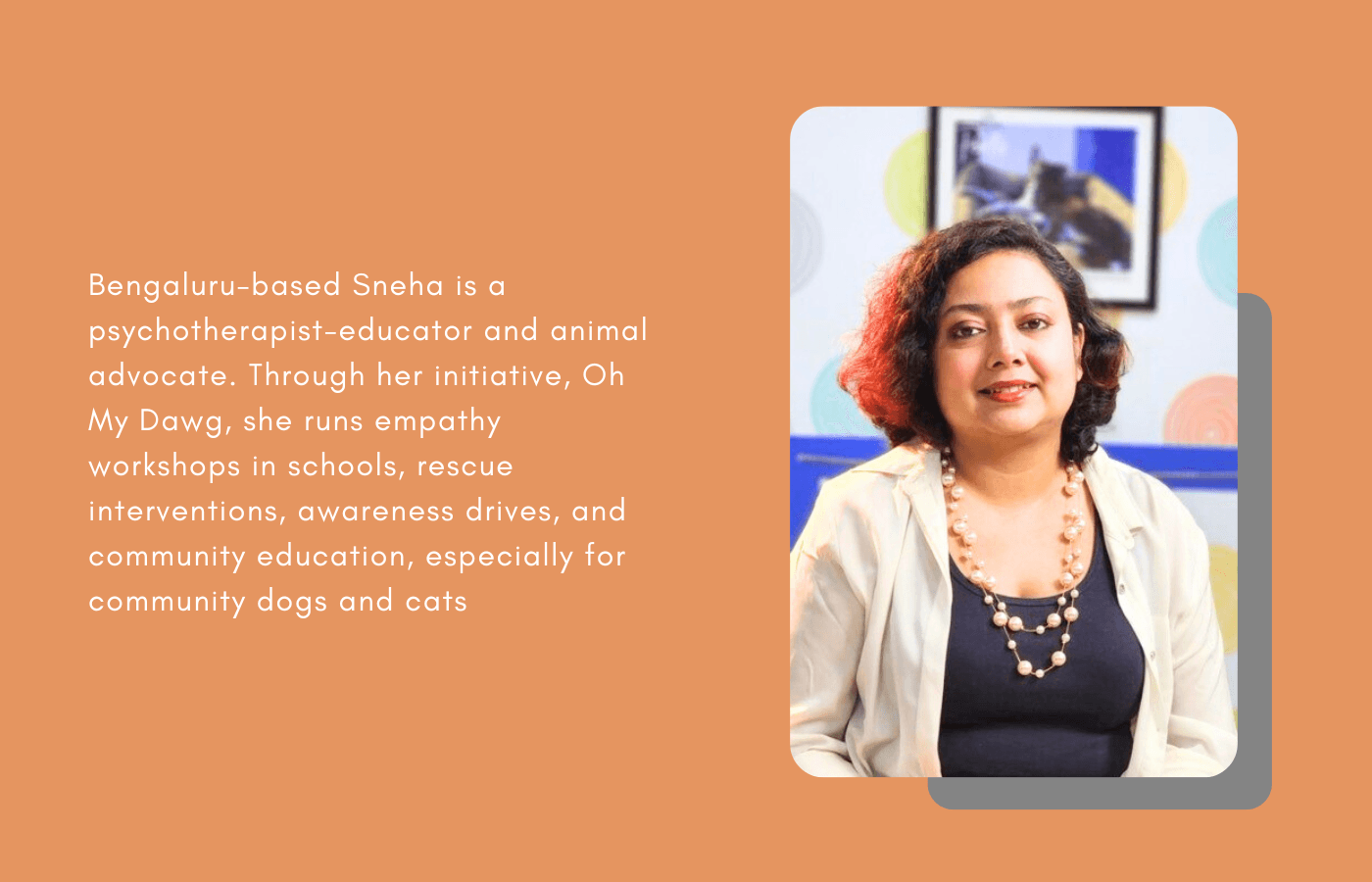
Bengaluru-based Sneha Paulchoudhury is a psychotherapist-educator and animal advocate. Over the past few years, she has been weaving together two worlds often seen as separate: mental health and community animal welfare. Through her initiative, Oh My Dawg, she runs empathy workshops in schools, rescue interventions, awareness drives, and community education, especially for community dogs and cats. Her journey from therapy to the streets, her philosophies on safety, grief, and cohabitation, lessons from rescue missions, and how she dreams of a world where animal welfare and human flourishing move hand in paw is exactly the kind of zen one needs on a busy day.
Origins and awakening
Sneha’s journey traces back to a childhood encounter that shaped her sense of empathy. She remembers seeing an injured puppy but being told she could not touch it.
“I had to eventually walk away as a little girl, not knowing how to help. I felt helpless and heartbroken, but also awakened.”
That moment, though painful, was formative. It revealed to her that animals experience pain and fear much like humans. Scholars have observed similar links, noting how early experiences with animals can cultivate empathy and responsibility in later life[1].

Years later, during her training as a psychologist, that memory resurfaced. “I saw the same need for empathy in both humans and animals.” For her, empathy was indivisible: the same recognition she once wanted to extend to a puppy became the recognition she now extends to people in therapeutic spaces. This bridging of human and animal needs is echoed in recent work on the human-dog bond, which highlights how compassion across species supports both well-being and resilience [2].
In reflecting on her beginnings, one senses that Sneha does not separate her professional and personal worlds. What could have remained a child’s heartbreak instead became a compass, guiding her toward a vocation where empathy, across species, forms the foundation. Yet a compass alone is not enough; it needs direction. The next step in her story was to turn empathy into practice, which she found not in clinics but in classrooms, where children could learn kindness through experience rather than instruction.
Workshops as healing spaces
When Sneha carries empathy into a classroom, she doesn’t begin with facts or warnings. She begins with a circle. “We sit together, and I begin with an icebreaker, asking each child to share one word about how they feel that day. It’s a gentle check-in, but it teaches emotional literacy.” This first step is deceptively simple. By helping children name feelings, she is introducing the language of inner worlds, something research shows is crucial for both emotional regulation and social connectedness.[3]
From there, she moves into role-play. Children imagine life as a street dog searching for food or shelter. “Afterward, we pause and reflect: ‘How did you feel in that moment?’ Children start to say things like ‘I felt scared,’ or ‘I felt unwanted,’ and they immediately make the connection to how animals actually feel.” Studies in India confirm that experiential activities with animals can significantly reduce fear and build compassion among children [4].
The session closes with action. “Children brainstorm small, concrete gestures: leaving water bowls outside, feeding dogs, avoiding harm. This part comes from cognitive-behavioural principles: linking awareness to small, actionable behaviours,” Sneha explains.
Reflection is woven throughout the workshop. The children move from naming their own feelings, to stepping into another’s life, to taking responsibility in small but real ways. In these movements, Sneha is demonstrating a therapeutic arc, from awareness to reframing, to action.
And yet, the classroom is only one stage. Empathy is often tested in life’s hardest moments, when grief and loss arrive.
Healing through loss and companionship
And for Sneha, grief arrived in waves with a painful miscarriage, a period she describes as isolating and heavy with grief. “It was a very isolating period, I felt nobody really understood what was going on inside me.” In the midst of that loss came an unexpected companion: a pup she named Google. “He didn’t give advice, he just sat with me, nudged me back to life, and reminded me what presence feels like”.
Google became her anchor. In psychology, the power of non-judgmental presence is often highlighted as core to therapeutic healing [5]. What Google offered her, being held without demand, is precisely what Sneha now seeks to recreate in workshops and in conversations with parents.
Companion animals, as recent studies note, can significantly buffer anxiety and foster recovery after trauma [6]. Sneha’s own experience echoes this: animals can become co-regulators of our nervous systems, offering safety and comfort when words fall short.
Safety, ethics, and coexistence
If empathy is the heart of Sneha’s work, safety is its backbone. She is clear that animal welfare comes first when she brings dogs into schools or community spaces. “I never bring community animals who are stressed, ill, or unaccustomed to children. Instead, I only bring two of my rescues, Miney and Momo, who are well-socialized and comfortable in public settings.” In her sessions, children are not rushed to touch the animals. Instead, they learn to observe cues, to ask permission, and to notice when a dog turns away. “Children are taught consent before they even touch the animal, they learn to read cues like a wagging tail or a dog turning away.”
Impact in numbers and stories
When asked how she measures impact, Sneha offers a layered answer. “On one level, yes, numbers matter: how many dogs or cats get adopted, how many sterilizations or vaccinations we support, how many schools we reach”. The quantitative outcomes show reach and scale. But for Sneha, the deeper evidence lies elsewhere.
“What matters most to me are the small shifts in behavior and attitude, because that’s what proves the model works long-term.”
One such moment came after a school workshop, when a teacher shared that children had started leaving bowls of water outside for community dogs. Another time, a parent told her their child chose to feed street dogs instead of throwing a birthday party.
Placed side by side, these stories illustrate what social researchers call the diffusion of prosocial behavior, the way small acts of kindness ripple through families and communities[8]. And unlike adoption counts or vaccination drives, these are harder to track but more revealing of cultural change. These subtle shifts, she believes, are what anchor communities in coexistence.
Holding grief, scaling hope
Animal rescue is often romanticized as heroic work. Sneha is honest about the weight it carries. “It does get emotionally taxing watching so many dogs and cats getting homeless and abandoned almost every day.” Rather than suppressing this grief, she gives it structure. “I journal, spend time with my own dogs who make me feel calm and grounded. I also practise what we call ‘containment’ in psychotherapy. I allow myself to feel grief, but I give it a container so it doesn’t spill into every part of my life.”
Her team, too, is guided by these principles. They debrief after rescues, sometimes formally, sometimes just by sitting together. Just as important, they celebrate small wins deliberately. “We also celebrate the small wins very deliberately, every adoption, every recovery, because joy is also part of resilience.” What Sneha is teaching is that joy is not a denial of suffering but its counterweight. Holding grief and joy together is what keeps the work human.
Looking ahead, she dreams of scaling her model while staying rooted. “If I were to take the Oh My Dawg model to another city, there are three non-negotiables I’d protect: the animal’s welfare, the psychology-led framework, and community education. The one thing I’d adapt would be the format of delivery.”
Sneha Paulchoudhury’s story begins with a child standing helpless before an injured puppy, and unfolds into a vocation that bridges therapy, education, and animal welfare. Her work with Oh My Dawg demonstrates how safety, grief, joy, and coexistence can be held together, reminding us that healing flows across species.
For those who wish to learn more or collaborate with her work:
LinkedIn: Sneha Paulchoudhury
Instagram (Oh My Dawg): @ohmydawg.blr
Personal Instagram: @evolvingwithsneha
References
Corfmat, J., Gibson, A. D., Mellanby, R. J., Watson, W., Appupillai, M., Yale, G., ... & Mazeri, S. (2023). Community attitudes and perceptions towards free-roaming dogs in Goa, India. Journal of Applied Animal Welfare Science, 26(4), 565-581.
Verbeek, P., Majure, C. A., Quattrochi, L., & Turner, S. J. (2024). The welfare of dogs as an aspect of the human–dog bond: a scoping review. Animals, 14(13), 1985.
Bailey, C. S., Martinez, O., & DiDomizio, E. (2023). Social and emotional learning and early literacy skills: A quasi-experimental study of RULER. Education Sciences, 13(4), 397.
Mondal, R., Protopopova, A., & Bhadra, A. (2023). The human-animal bond and at-home behaviours of adopted Indian free-ranging dogs. Applied Animal Behaviour Science, 268, 106014.
Branson, D. C., Martin, J. S., Westbrook, O. E., Ketcherside, R. J., & Bradley, C. S. (2022). “Why people gotta be so judgy?”: The importance of agency-wide, non-judgmental approach to client care. Alcoholism Treatment Quarterly, 40(1), 65-82.
Ellis, A., Hawkins, R. D., Stanton, S. C., & Loughnan, S. (2024). The association between companion animal attachment and depression: A systematic review. Anthrozoös, 37(6), 1067-1105.
Gray, H., Boa, S., & Cassidy, T. (2024). O-03 Using ripple effect mapping to capture the impact of compassionate community building on community connection and wellbeing.
Koller, E. C., Abel, R. A., & Milton, L. E. (2022). Caring for the caregiver: A feasibility study of an online program that addresses compassion fatigue, burnout, and secondary trauma. The Open Journal of Occupational Therapy, 10(1), 1-14.
Golestaneh, H., & Sadeghi Naeini, H. (2024). The Transformative Role of Design for Social Innovation in Community Development at the Local Level. Quarterly Journals of Urban and Regional Development Planning, 9(31), 31-67.