The Supreme Court of India has ruled that stem cell therapy cannot be used as clinical treatment for autism spectrum disorder, declaring that offering such interventions outside approved and monitored clinical trials is unethical and amounts to medical malpractice.
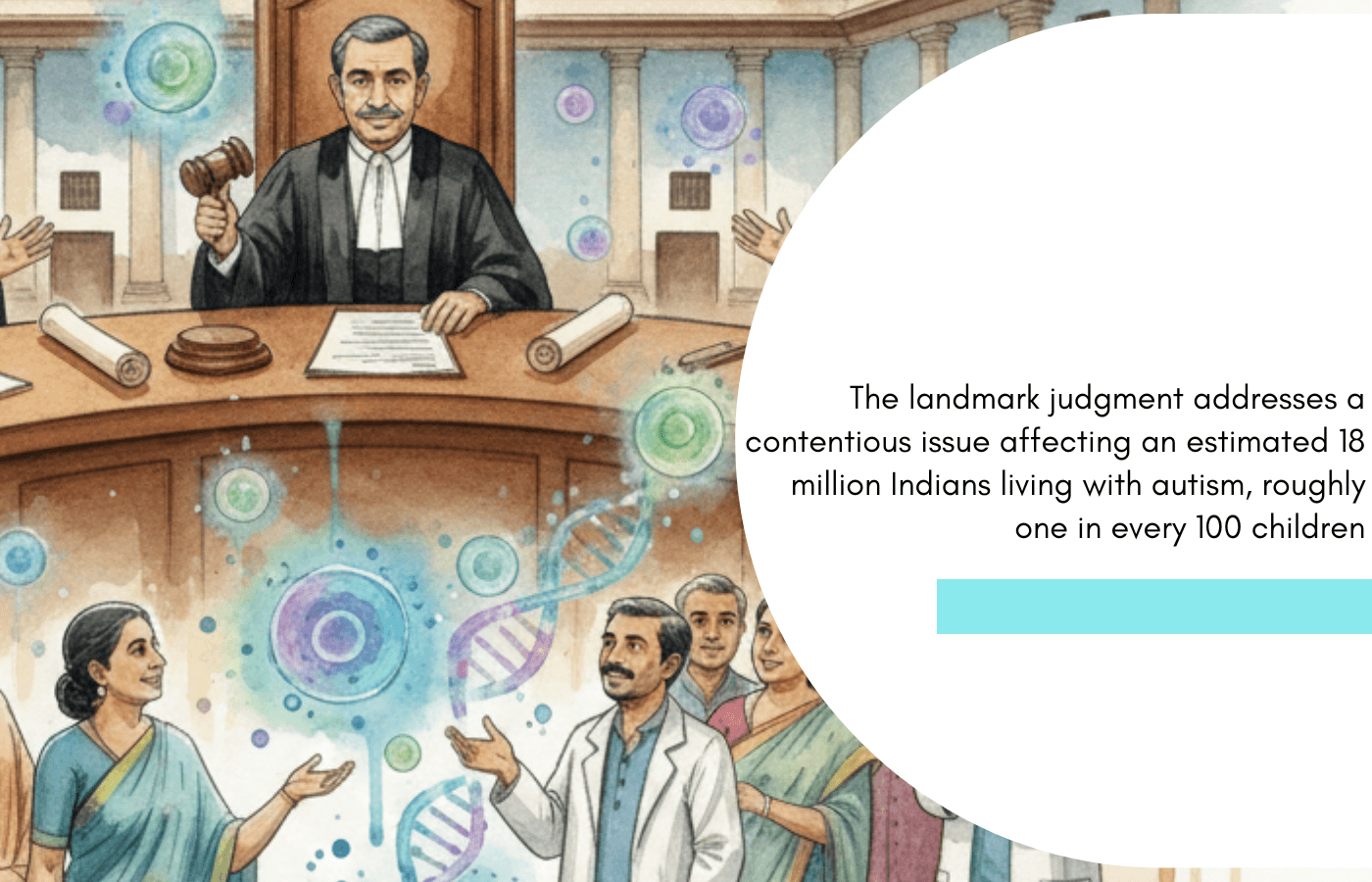
The landmark judgment addresses a contentious issue affecting an estimated 18 million Indians living with autism, roughly one in every 100 children. For years, desperate families have sought experimental stem cell treatments costing ₹4-10 lakhs ($4,800-$12,000), even as medical regulators warned these therapies lack scientific evidence of safety or effectiveness.
What the court decided
Justice Pardiwala, delivering the verdict, emphasized that stem cell interventions are permissible only within approved, regulated, and monitored clinical trials aimed at advancing scientific knowledge, not as routine therapy offered to patients.
"Every use of stem cells in patients outside an approved clinical trial is unethical and must be treated as malpractice," the bench stated.
The court held that stem cell therapy for autism fails to meet the criteria of providing "adequate information" required for valid medical consent. Patients and caregivers are often led to expect therapeutic benefits from an intervention lacking scientific proof, which constitutes a serious violation of medical ethics.
The ruling clarifies that simply because stem cells fall under the definition of "drugs" in the Drugs and Cosmetics Act, 1940, their use cannot automatically be justified as permissible clinical service.
Protection for current patients
In a crucial clarification, the court stated that patients already undergoing stem cell therapy should not be prejudiced abruptly. However, their treatment cannot continue as a routine clinical service.
The court directed the National Medical Commission, AIIMS, and the Secretary of the Ministry of Health and Family Welfare to ensure such patients are rerouted into properly approved clinical trials. This ensures patient safety while preventing unethical continuation of unproven therapies.
The science says no
The Indian Council of Medical Research (ICMR) issued comprehensive guidelines in 2021 stating unequivocally that stem cell therapy should not be offered as standard therapy to patients with autism.
According to ICMR's detailed review, published studies suffer from critical flaws: small patient numbers, lack of control groups, unreliable assessment tools, no long-term follow-up data, and reliance on caregiver assessments prone to bias. One 2013 study reported a 9% seizure rate after stem cell therapy for autism.
A 2020 review published in Molecular Autism concluded that the only placebo-controlled study resulted in a negative outcome, while open-labeled studies provided "mixed and, in most cases, ambiguous outcomes."
The World Health Organization and International Society for Stem Cell Research have both cautioned that premature clinical use of stem cells can expose patients to unknown risks, including immune reactions, infections, and long-term complications.
The consent problem
One of the most significant aspects of the judgment addresses informed consent. The court held that consent is invalid if not based on adequate and credible scientific information.
Because stem cell therapy for autism lacks established evidence of safety and efficacy, patients cannot make truly informed decisions. The justices noted that offering a choice between no treatment and an unproven therapy does not amount to valid consent, especially when families are emotionally vulnerable.
Parents of autistic individuals are especially vulnerable to being exploited by those who claim they have a ‘cure’ for autism. While it is understandable that most parents grapple with grief over their children not being ‘typical’ or not achieving expected milestones, it is dangerous to let desperation prevent an objective evaluation of so-called treatments that are out there in India.
There is no medical "fix" for autism because it is not a disease; it is a difference in how the brain is wired. When we view autism solely through a "deficit-based" lens, we overlook the individual's inherent potential. Working with strengths, skill-building, behaviour therapies, and creating environments that support rather than overwhelm – all these are proven strategies that benefit autistic children.
The idea should not be to make autistic children behave or act ‘normally’, rather it should be to recognize, accept and celebrate the individuality and capabilities of a different mind. Stem cell therapy is unproven and cannot be a substitute for consistent support and individual-centric interventions. A lot more awareness needs to be in place so that parents don’t overlook safety and science in the relentless pursuit for a cure.
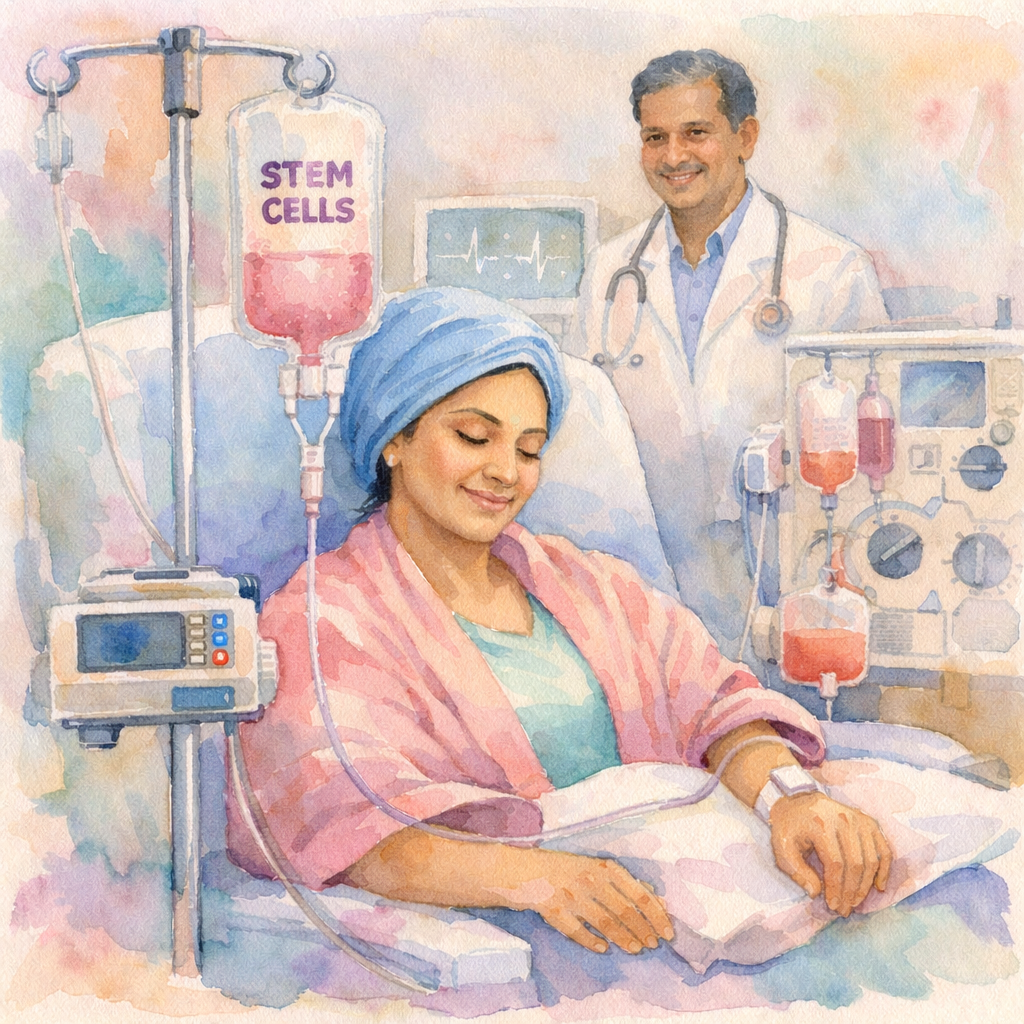
The Supreme Court ruled that a doctor breaches the reasonable standard of care if treatment is administered without credible scientific evidence or when authoritative medical bodies have clearly stated the intervention is not recommended.
This means doctors offering stem cell therapy for autism outside approved clinical trials can now face professional misconduct charges, civil liability for negligence, and potentially criminal charges depending on outcomes.
What treatments actually work
Medical experts emphasize that while there is no cure for autism, multiple evidence-based interventions have proven effective in supporting individuals with the condition.
Applied behavior analysis uses behavioral principles to improve developmental skills through step-by-step instructions and reinforcement. Speech and language therapy helps improve communication abilities. Occupational therapy teaches skills for independent living and can include sensory integration approaches.
Early intervention programs combining developmental and behavioral approaches have shown promising results for young children. Parent-mediated interventions, where parents acquire specific skills to improve their child's functioning, have also demonstrated effectiveness.
According to research, early intensive behavioral intervention is effective in improving social skills and communication, as well as reducing sleep, eating, and toileting problems.
The regulatory journey
The Supreme Court's decision comes after years of conflicting signals. In December 2022, the National Medical Commission's Ethics Board recommended that stem cell therapy for autism should constitute professional misconduct, citing insufficient evidence.
However, in August 2023, the Delhi High Court allowed two children with autism to continue stem cell therapy after families challenged the recommendations. The court noted there was no law explicitly banning the practice.
This regulatory vacuum allowed stem cell clinics to flourish across Delhi, Mumbai, Pune, and Bangalore, charging families substantial sums for what clinics marketed as standard treatment but was actually unproven experimental therapy.
The business of desperation
According to ICMR bioethics guidelines, participants in legitimate clinical trials should not pay for research-related expenses, including the stem cells themselves. Yet many families have been charged between ₹4-10 lakhs for treatments.
The ICMR guidelines note that desperate patients from countries with stricter regulatory enforcement, including the United States and Europe, travel to countries like India seeking unproven stem cell therapies.
What happens now
The ruling creates immediate implications:

For families: The judgment protects vulnerable families from exploitation while ensuring any potential benefits can only be discovered through properly conducted studies that don't charge participants.
For stem cell clinics: Facilities offering stem cell therapy for autism outside approved clinical trials must cease operations or face medical malpractice charges.
For researchers: Properly designed clinical trials with regulatory approval, informed consent, and no-cost participation remain permissible and encouraged.
For medical practitioners: Offering stem cell therapy for autism outside approved research protocols now carries clear legal liability.
What families should know
Experts emphasize several critical points for families navigating autism:
Early intervention matters: The most effective interventions begin as early as possible, ideally before age three, when brain plasticity offers maximum opportunity for developmental gains.
Beware of cure promises: Any provider promising to cure autism should be viewed with extreme skepticism. Autism is a lifelong condition, though appropriate support can dramatically improve quality of life.
Clinical trials are free: Legitimate clinical trials never charge participants for investigational treatments. If you're being asked to pay substantial sums for "experimental therapy," it's exploitation, not research.
The broader message
The Supreme Court's ruling sends a clear message: medical innovation cannot come at the cost of ethics, evidence, or patient safety. By prohibiting stem cell therapy for autism outside regulated research, the court has drawn a firm line between scientific exploration and exploitative medical practice.
For families affected by autism, the judgment reinforces the need for evidence-based care, behavioral interventions, and long-term support, while ensuring that future research proceeds responsibly. For the medical community, it establishes accountability, making clear that unproven treatments offered as therapy have no place in ethical healthcare.
This move shows that increased investment in proven autism interventions is needed, along with better access to affordable, evidence-based care for the millions of Indian families navigating this complex condition.