As a first-person essay, this does not require review by our team of Reviewers. Barring minor changes for grammar and sentence structure, we have kept the voice of the author intact.
My mother, Manju Sharma, grew up in Hatkeshwar Gali — a lane named for a Shiva temple, in the old Hindu quarter of Agra: the Braj-adjacent, temple-centered, vegetarian city that sits inside the city the world knows for its Mughal monuments. Her lane was near a branch of the Nagri Pracharini tradition — the century-old movement founded by three ninth-grade boys in Varanasi in 1893, dedicated to moving unwritten Hindi knowledge onto the page in Devanagari before it could be lost. She grew up in the atmospheric field of that idea. She would not have called it that. She simply grew up inside the assumption that a woman with a pen could keep something alive.
She read voraciously as a girl. After her BA, her family did not allow her to continue at a co-ed college, so she completed an MA in Sociology through distance education, without her own textbooks, borrowing a friend’s sister’s used books in the weeks before her exams. She cleared it. She then applied to the Indian Police Service. Her application was accepted but it was a door her family would not let her walk through. The pen, in her hand, would have to wait several more decades to be picked up again.
She was married instead to my father, Satya Prakash Sharma, a schoolteacher and a devoutly religious man. She packed her life into trunks and moved with him to Arunachal Pradesh. She had never heard of this place before her wedding day. Their first posting was in Lumla, a tiny border town wrapped in snow.
My mother saw snow for the first time in her life there. She had to learn survival skills on the fly, including how to light a bukhari. This Persian-named wood-burning stove-heater had traveled the Himalayan belt from Central Asia through Kashmir and Ladakh before settling into the homes of Arunachal as the only defense against a Lumla winter. On one of her first attempts, the fire caught so suddenly it almost burned her eyebrows off. My father helped her manage it, and she quickly got the hang of it and worked through the cold.
Together in the mountains, they built a life and raised four children. My mother did not cry out her homesickness; she cooked it. For decades in Arunachal, long before she began teaching young children in the years after I turned 17, the kitchen counter was her tether to home.
Manju Sharma
Thousands of miles away from her ancestral roots, she recreated the precise vegetarian flavors of her childhood — dishes from a wheat-forward, spice-heavy, temple-adjacent tradition that had never been anchored to paper, only whispered from mother to daughter and measured by the weight of a palm or the instinct of a scent. In the Agra she grew up in, the kitchen had been a woman’s country, and its knowledge moved on the assumption that the chain would not break. Marriage and 8,000 miles had broken it. The kitchen counter in Arunachal was her repair.
The bed in Agra
My mother was a woman of unbreakable grit. Her body faced trials that would have sidelined anyone else. She spent years navigating the grueling routine of dialysis before undergoing a major kidney transplant in 2016. She never lived like a patient but like a custodian of our family’s spirit.
In 2019, while back in Agra, she broke her leg and was confined to weeks of strict bed rest. For a woman used to constantly moving, the stillness could have been a prison. Instead, she picked up a pen.
She began archiving the ancestral vegetarian recipes of her childhood — dishes passed down strictly through oral tradition, things that had never been anchored to a page. She wrote in Hindi, in Devanagari, the language and script the recipes had always lived in. With every stroke she was physically transferring generations of memory out of the ether and onto paper, racing her own body to make sure our history would not vanish.
She would not have named the tradition she was working inside, but she was doing on the scale of one household exactly what Nagri Pracharini Sabha had set out to do on the scale of a language: move unwritten Hindi knowledge onto the page before it could be lost. This time the pen was finally in her hand, and no one was going to take it away.
The two years that weren’t planned
In January 2020, she flew across the world to California to be by my side in Dublin for the birth of my son, Ayansh. She was only supposed to stay for a few months. Then the world shut down.
As COVID-19 spread, her status as a post-transplant recipient meant her immune system was incredibly vulnerable. Airports, crowds, international flights — all of it closed to her. What was meant to be a brief visit became more than two years none of us had planned for.
By this time, arthritis had taken a heavy toll on her knees, and walking had become a painful daily struggle. Yet almost every afternoon she would walk into the kitchen anyway. She would stand at the counter, one hand resting firmly on the edge for balance, and cook. I offered her a chair more times than I could count; she waved me off with a smile. In that kitchen, standing on her own two feet, she was entirely in control.
This was how she verified the notebook she had written on bed rest. She did not have a cookbook to reference; she relied entirely on memory and instinct, testing each dish to make sure the flavors matched what she had written. I sat with her handwritten notebook and translated the Hindi into English at the counter as she cooked. Once a recipe passed her taste test, my sister Richa and I edited the translation together — cleaning it for the page, but leaving her voice untouched.
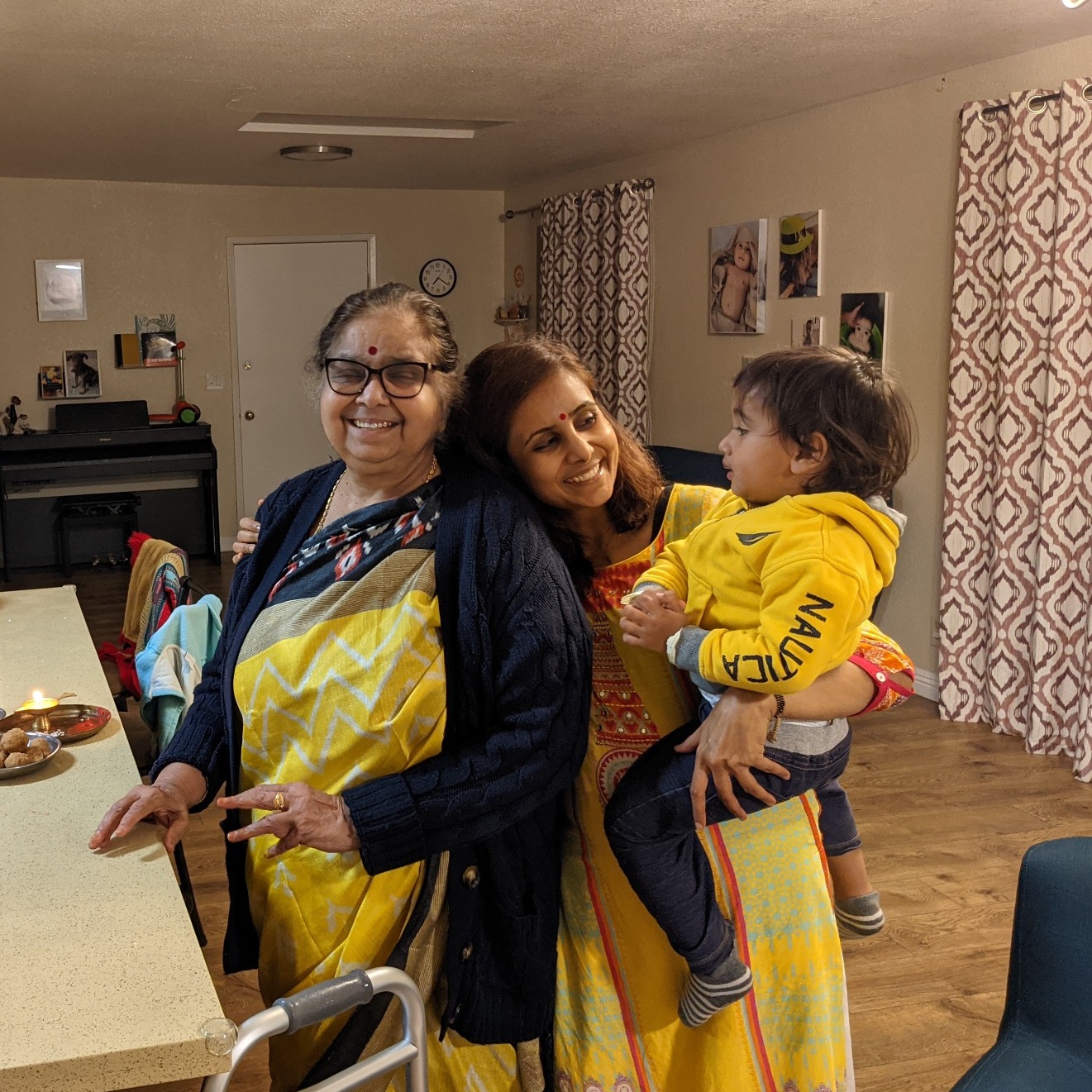
Manju, Prachi, and son Ayansh
My son was barely a year old, far too young to understand. I would prop him up in his highchair at the edge of the kitchen so he could watch her. He would sit there for hours, his eyes locked onto her moving hands the same way mine were. To keep him happy, she would tear off a piece of raw wheat dough and pass it to him. That became his childhood — playing with organic playdough made fresh by his grandmother’s hands, right there on the counter where a family’s legacy was being preserved.
The traveler’s bread
“People used to make anga in earlier times before any long travel,” my mother told me one afternoon, her arthritic hands deftly shaping a smooth ball of wheat dough in her palms. “Only oil, salt, and wheat flour, kneaded with just a little water so that it doesn’t go bad quickly. They would pack these fist-shaped balls into their bags and cook them directly over an open fire. This was a time before cars or buses, when people traveled on foot, often through dense, unpredictable forests. The dough, cooked that way, was eaten with ghee and pickle, or sometimes a piece of jaggery. It keeps for days.”
Her own grandmother had made anga in a chulha, for people setting out on foot to temples, and for villagers leaving their homes to look for work in places they had never been. My mother had never seen it made in her own kitchen. By the time she learned to shape it, the chulha had already left her life and she cooked it on a stovetop. By the time I cooked it for Ayansh, it came out of an oven. Same fist of dough. Same salt, same wheat, same purpose — a food engineered so that people leaving home would not go hungry on the way.
I watched the same hands that had once nearly caught fire on a Lumla bukhari now shape dough at a California counter. She would cook it over the stove, taste it, and adjust the spice or the moisture from memory. Only when she nodded in approval would she let me write down the final version.
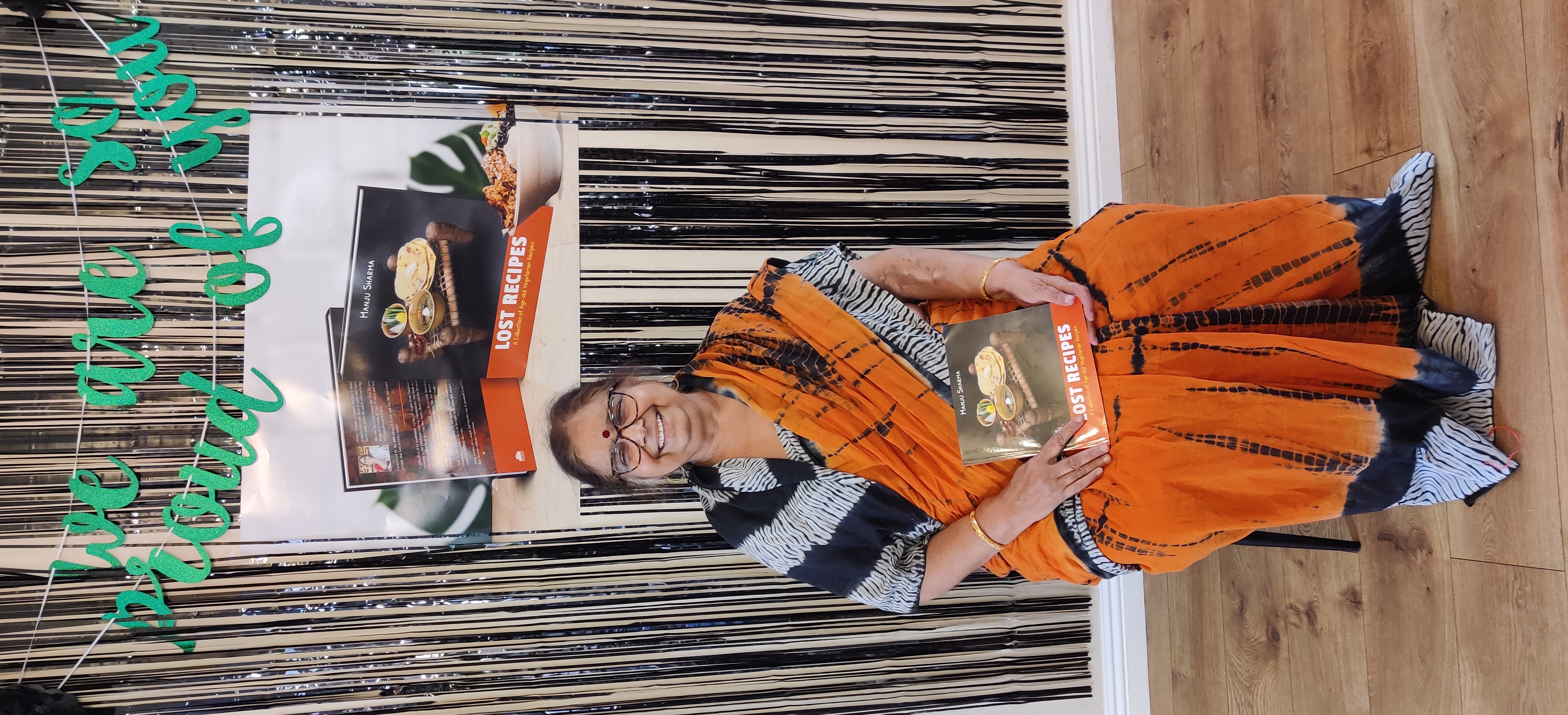
In April 2021, the book was published. She had chosen to title it The Lost Recipes — a collection of the vanishing dishes of her childhood, saved just in time.
The doorway
In March 2022, international travel restrictions finally eased, and my mother was eager to fly home to India to see the rest of our large family. Three weeks after her flight landed, she passed away suddenly. There was no long illness, no warning — just a backache the day before, and then she was simply gone.
The title of her book feels too heavy, too fitting now. She wrote down what was about to be lost, and not long after, I lost her too. It began on a bed she could not leave in Agra, and it ended in a kitchen far from home, during two years none of us ever asked for and none of us will ever forget.
I think about her every time I step into the kitchen now. Last week, I tried making anga on my own. Without her steady hands guiding me, I got it wrong. I added too much water, ruining the stiff, durable consistency she had explicitly taught me to maintain. As I stood there struggling, Ayansh, older now, stood in the kitchen doorway and watched me the same way he used to watch her from his highchair. He looked at the counter and asked if this was the bread his grandmother used to make.
I nodded. I did not tell him I had made a mistake. I handed him a warm piece anyway, with a dollop of ghee and jaggery on the side, just like she always did. He ate it happily, smiling, never knowing anything was off.
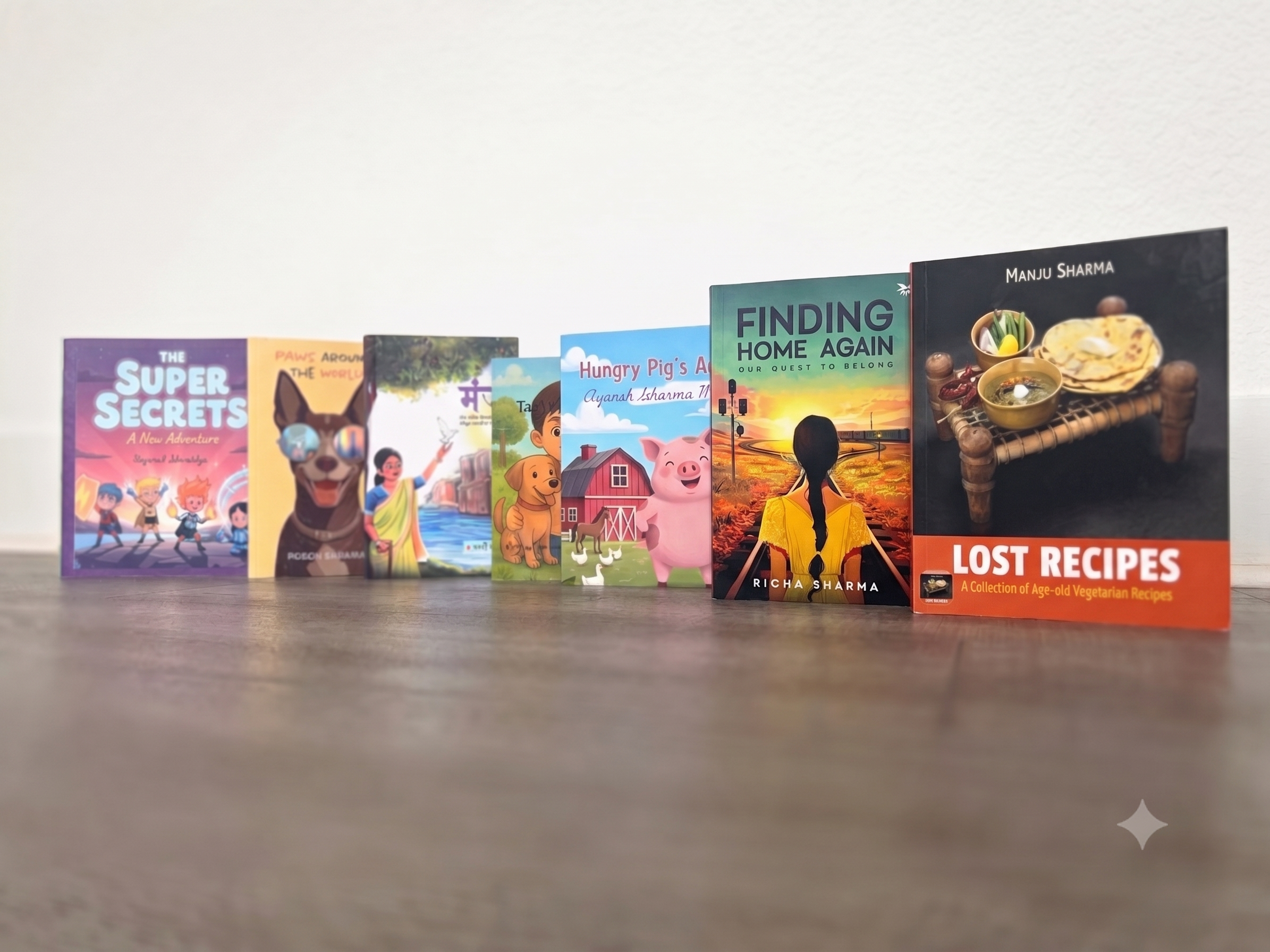
From the spine of her notebook, a whole shelf has grown. Alongside her The Lost Recipes sits my Manju: A Life of Grit, Grace and Greatness; my sister Richa’s Finding Home Again; my own Paws Around the World. And the youngest hands are already holding pens: my nine-year-old nephew Reyansh’s The Super Secrets, and my six-year-old son Ayansh’s own published creations, Tag, You’re It! and Hungry Pig’s Adventures!
One afternoon after the first copy had arrived from the printer, I walked past her bedroom in our California home and stopped in the doorway. She was sitting on the bed with the finished book in her hands, running her fingers slowly over the cover, smiling quietly to herself. She never knew I was watching.
That image — my mother alone with the book that held everything she had rescued, in a house 8,000 miles from the lane where she was born, in the same script she had been raised inside — is my sanctuary now.
Images credit: Prachi's photo in header image from KQED.ORG. All other images provided by the author.
Continue the Healing
Stories like this one helped 23 Indians share their truth.
Read the MyndStories Anthology — first-person essays on anxiety, grief, identity, and the slow work of healing.
Sumit Singla writes a semi-monthly column on ADHD, parenting, life, animals, and other distractions. In this first column he writes on how his ADHD diagnosis helped make sense of his world