The Therapy Room is a MyndStories Special where mental health experts offer help and guidance on mental health issues, relationships, and wellbeing.
As people, we all have a need for connection and belonging. This is something that we are all aware of. We have so many movies and books written about the relationships we share. We daydream about the kind of relationships we would like to have. However, finding, creating, and honing such a relationship can be challenging.
It requires us to be vulnerable and trust the other person with our emotions. It requires following the rules of social etiquette. Very often, these norms may be in direct conflict with how we feel. These norms may encourage us to engage in behaviors that do not feel comfortable to us. We may want to hug someone and tell them that we love them, but we might be scared to do so in public. We may want to tell them to stop talking to us rudely, but we may continue smiling and nodding our heads.
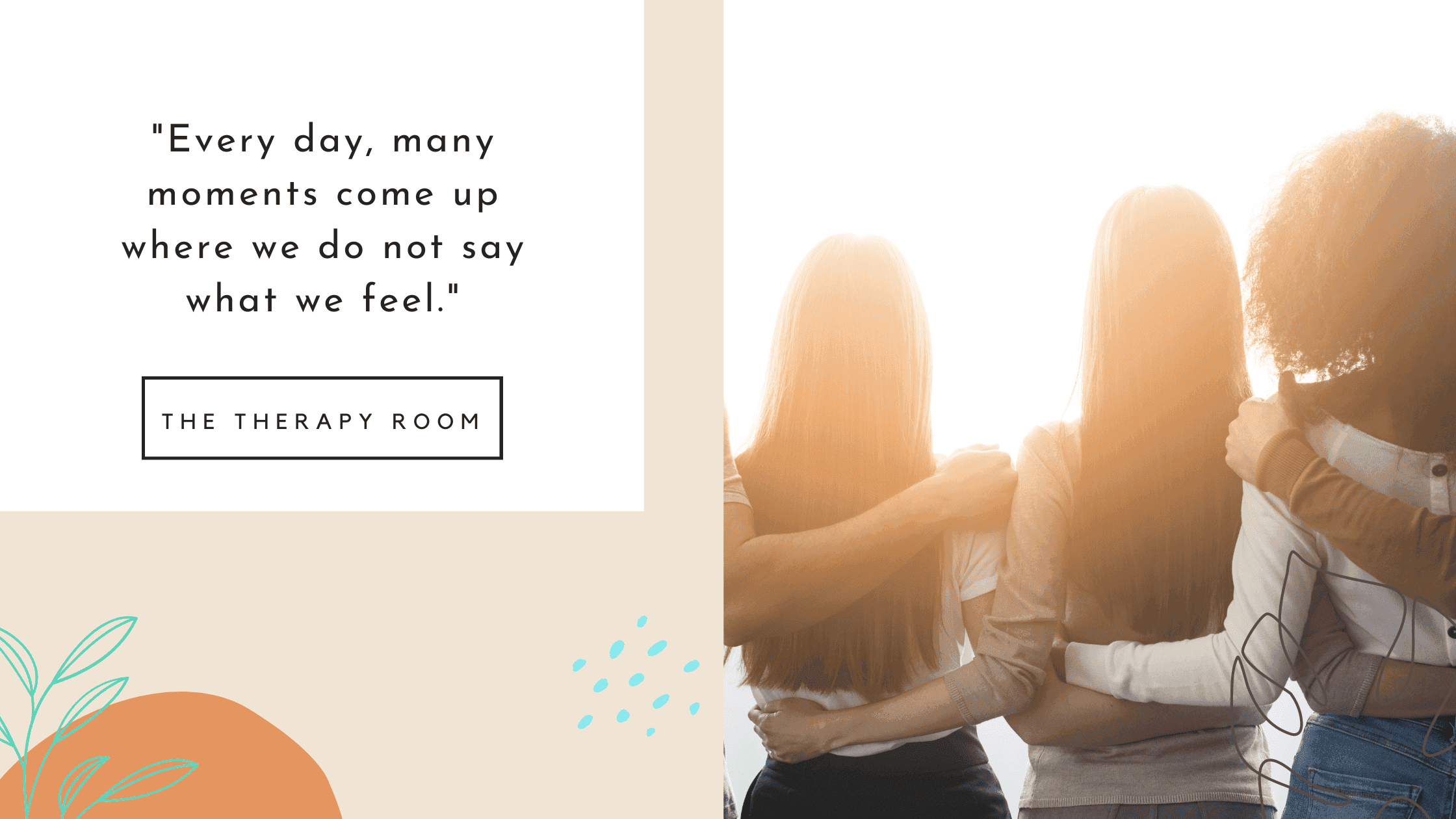
Every day, many such moments come up where we do not say what we feel. Every day, many such moments may come up where we do not act according to how we feel. When our ability to communicate is inhibited, it can become really hard to establish a healthy relationship.
Along with the social norms that can make it hard to connect with others freely, three other barriers affect our cognitive and emotional sides and make it difficult to express who we are.
Lack of awareness
Our identities have multiple layers, most of which are unseen. Our appearance may hint at some aspects of our identity, but even these hints may not be fully accurate. Our gender, racial, professional, socioeconomic statuses, neurodivergence, and the other systems that contribute to our identity can only be guessed. The best way to know is by asking the other person.
However, it can be hard to seek answers if the other person is also unaware of certain aspects of their identity. For instance, they may know what gender they belong to, but they may not be able to articulate what makes them belong to that gender identity. If someone were to challenge their unexpressed idea of gender, it could be very triggering as one is exposed to a whole new side of an identity that they have not fully explored. They might be able to express themselves, but they may also hold onto the rules that do not favor them by holding on to this identity without challenging it.
When we do not take the time to get to know ourselves, it can be hard to express ourselves authentically.
When we do not take the time to get to know these parts of who we are, we are in denial. Hence, when others talk about these parts of us, we might get triggered and close our gates to communication.
Lack of safety
The more unaware we are of our own identity, the more we get triggered and feel uncomfortable. The more we feel uncomfortable talking to other people, the harder we find it harder to feel safe and secure in that relationship. Even though we may try to be tolerant, this feeling can continue to nag us.
We may have to keep shifting between our feelings, our thoughts, and societal expectations. It can be exhausting and frustrating to feel so confused and worried about what to say. We may also lash out at the other person in anger or get into our shells and avoid connecting with people. Both these behaviors make it hard to build a healthy connection.
Lack of empathy
Empathy is defined as the ability to put ourselves in someone else’s shoes and see the world as they do. When we are caught up in our own inward spiral, it can be hard to process or understand the other person’s perspective. When we are so invested in trying to understand our own experiences, it can become really hard to build a connection. For a connection to be forged, everyone involved must be fully present. Partial listening before responding or holding on to one’s opinion strongly, with no room for dissent, stops the flow of conversation.
So, how can we overcome these barriers?
Increasing awareness
As we can see, developing self-awareness can help us develop meaningful connections. 3 ways to do this are:
- Journaling: Write what you feel every day. When we do this, we increase our access to language. This helps to get in touch with the parts of ourselves that feel unseen and unknown.
- Feeling wheel: The one struggle that commonly comes up among my clients is the usage of feeling words. We are so used to saying that we are “fine” or “good” that we rarely use words like angry or excited. The feeling wheel gives you access to multiple words that you can use to describe how you are feeling.
- Body scan: Our bodies are an excellent source of information. They indicate any discomfort or comfort. By tuning into our sensations and giving them words, we can increase our self-awareness.
Building safety
It is important to feel safe in your body. As this relationship with your language grows, your body needs to be sufficiently regulated so that it can receive new insights.
- Mindfulness: Find a quiet space to sit in. Close your eyes, relax your body, and tune into the world around you. In this exercise, we are shifting our focus from our inner worlds to the world around us. Focus on your breath and when you are ready, open your eyes.
- Art: Sit with your body scan. Wherever you feel very anxious, mark it on an outline of the body. Give it a color, a texture, and a shape. You can use any medium you like, and you can use any shapes and lines you like.
Developing empathy
- Practice: Watch a movie and try to connect with a character. Write a letter to them and see how you connect. Pause when you are zoning out and return to the movie as often as you need.
Building deeper connections can be extremely overwhelming. However, the ability to see the person in front of you and to be seen by them in your most authentic form truly lets you have a connection like no other.
All the questions in your head that make you wonder if they love you or if you are too much, begin to quiet down. There is a risk of getting hurt, but it comes with the possibility of being loved for who you are. Plus, the more you practice, the better you get, know?