In March 2026, Understood.org, the U.S.-based nonprofit focused on learning and thinking differences, released a comprehensive research report titled "Missed, misread, and misdiagnosed: Current state of women with ADHD." The findings are sobering, and they point to something that clinicians, educators, and women themselves have been saying for years: the system is failing women with ADHD.
How the study was conducted
This was a multi-method study. Understood.org partnered with Human Dot Plus to analyze 1.2 million online conversations of women about ADHD, capturing the scale and texture of how women talk about their experiences. A survey of 846 girls and women was conducted by research firm F'inn. The study also included a comprehensive literature review. The combination of conversation analysis, survey data, and academic research gives the findings a level of depth that is rare in this space.
The numbers that should concern all of us
The headline finding: most women with ADHD are living with multiple mental health conditions at the same time.
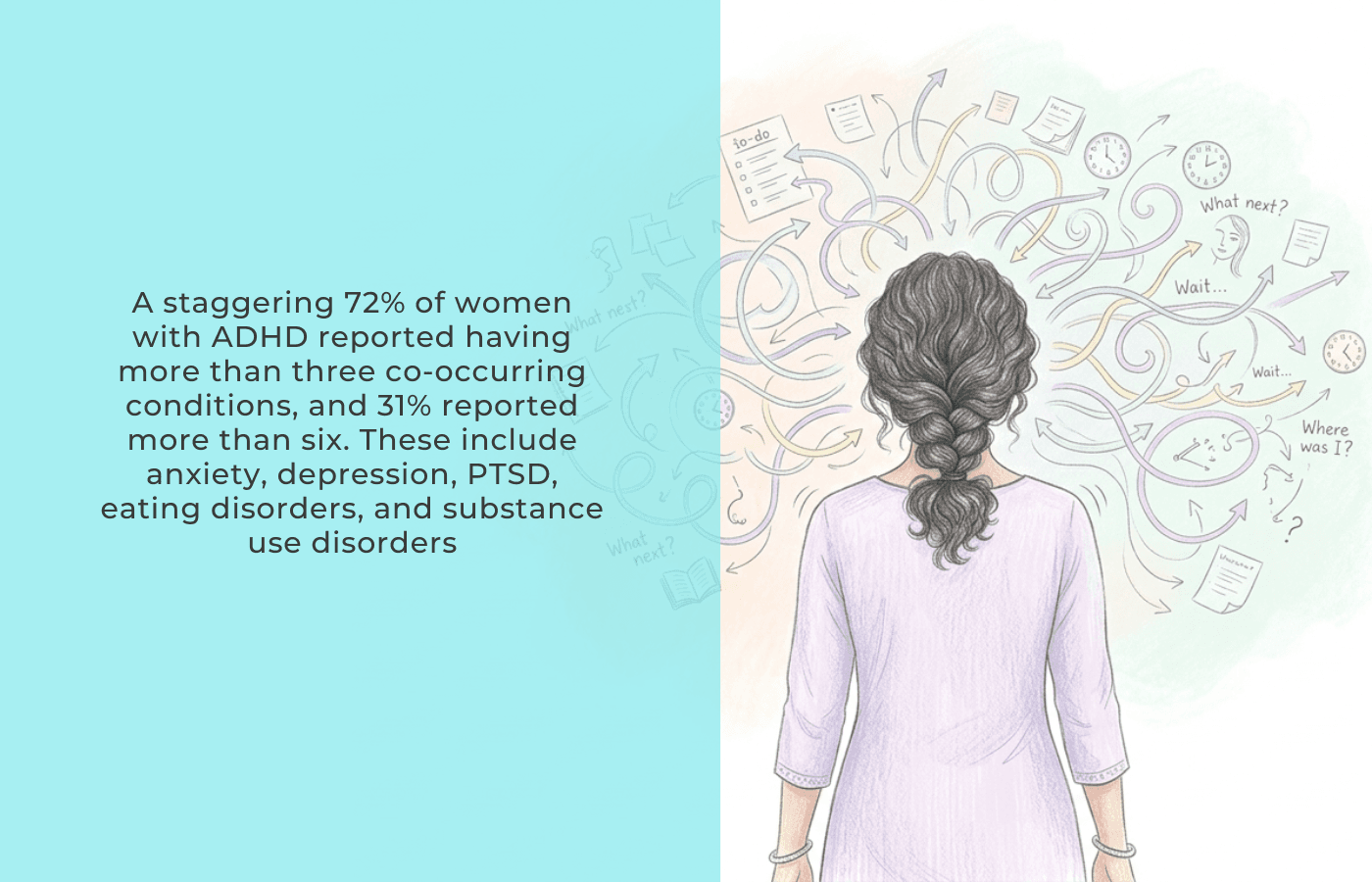
A staggering 72% of women with ADHD reported having more than three co-occurring conditions, and 31% reported more than six. These include anxiety, depression, PTSD, eating disorders, and substance use disorders.
Forty-four percent of women said they were first diagnosed with another condition, like anxiety or depression, before their ADHD was identified. That delay matters enormously. It means years of treatment that addresses the symptoms but misses the root cause. It means women spending their twenties and thirties wondering why they cannot seem to "get it together" when the answer was neurological the entire time.
Perhaps the most striking finding: 89% of women with ADHD reported damaged self-confidence from misattributing their neurobiological symptoms to personal character flaws. They blamed themselves for being "lazy," "scattered," or "too emotional" when what they actually had was a brain that processed the world differently.
The toll on women's lives
The research also found that 23.5% of women with ADHD reported a lifetime history of suicide attempts, significantly higher than the 8.5% rate among men with ADHD. This disparity is alarming, and it speaks to the compounding effect of living undiagnosed or misdiagnosed for years: the shame, the self-blame, the exhaustion of trying to meet standards that were designed for a neurotypical brain.
New ADHD diagnoses among women have nearly doubled in recent years, which is a positive development. More women are finding answers. But the research also estimates that between 50% and 80% of women with learning and thinking differences remain undiagnosed or misdiagnosed. The gap between awareness and actual care is still enormous.
BIPOC women and mothers face wider gaps
The report specifically highlights that the gaps are even wider for BIPOC (Black, Indigenous, and People of Color) women and for mothers. Research on neurodivergent women, including those with ADHD, remains extremely limited, and the data on BIPOC women is thinner still. This matters because the diagnostic criteria, the clinical norms, and the support systems were largely developed based on studies of white boys. Women of color are navigating a system that was never designed with them in mind.
For mothers with ADHD, the challenges are compounded. The executive function demands of parenting, managing households, schedules, emotional regulation for themselves and their children, can push already-stretched coping systems to a breaking point. And these mothers are often judged harshly for the very struggles that stem from their undiagnosed or poorly supported condition.
Why this matters in India and beyond
While this study was conducted in the United States, its implications travel. ADHD in women is underdiagnosed globally. In India, where the conversation about ADHD is still in its early stages and is often limited to children (and mostly boys), women with ADHD are almost entirely invisible in the healthcare system. There is very little research, very few clinicians trained to identify ADHD presentations in adult women, and almost no culturally specific support.
If you are a woman who has ever felt like you are working twice as hard as everyone else and still falling short, if you have been told you are "too much" or "not enough," if your anxiety or depression treatment has helped but something still feels off, this research might be worth reading. Sometimes the most powerful thing a study can do is give a name to what you have been carrying