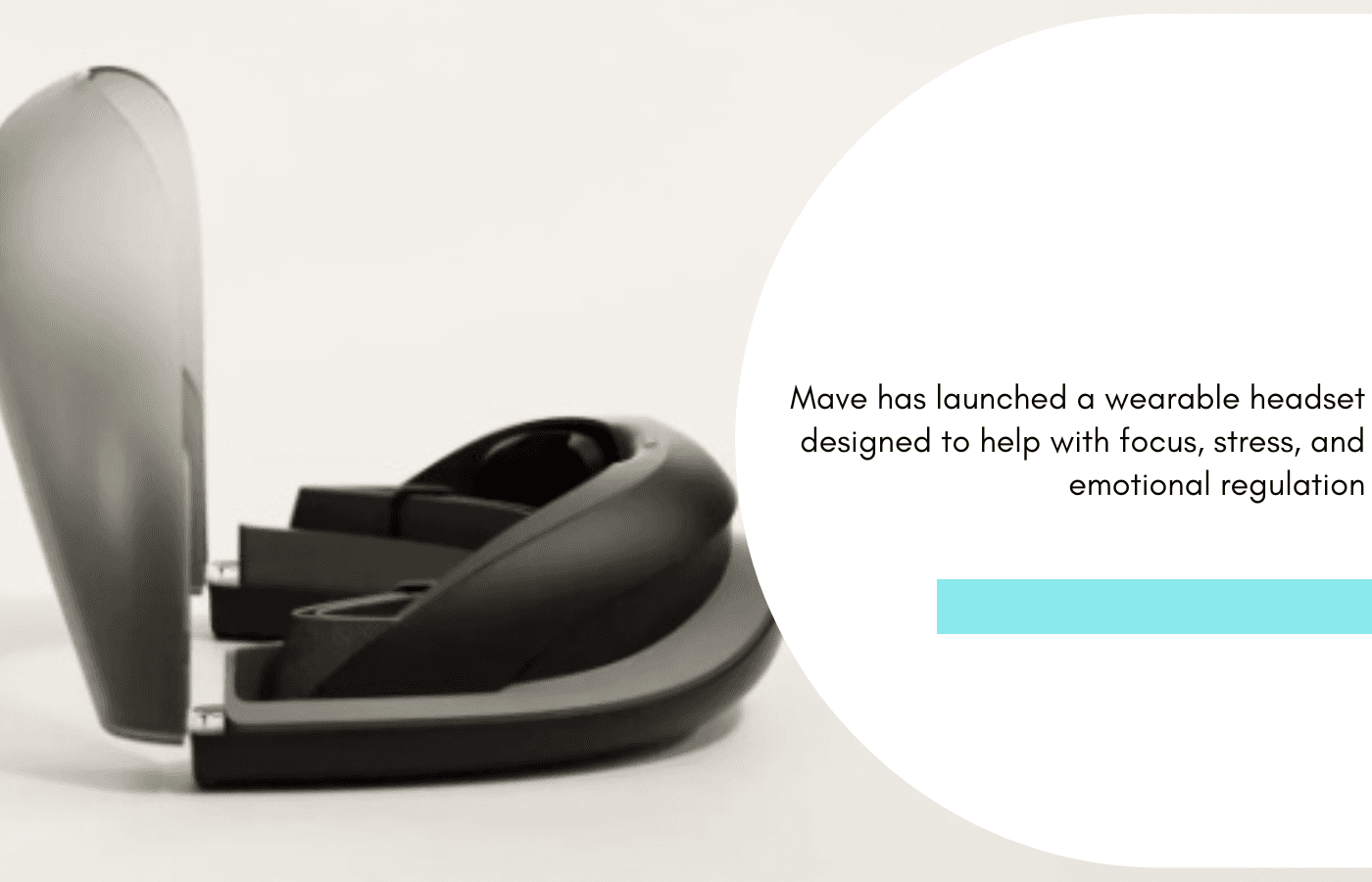
A Bengaluru and San Francisco-based neurotechnology startup called Mave Health has raised $2.1 million in seed funding to launch a wearable headset designed to help with focus, stress, and emotional regulation. The round was led by Blume Ventures, with participation from Inuka Capital, Stanford Angels, All In Capital, Aureolis Ventures, the founders of Groww, and angel investors including Dhaval Shroff and Raymond Russell.
This brings the company's total funding to nearly $3 million, including a $750,000 pre-seed round raised in 2023.
What Mave Health does
Mave Health builds non-invasive wearable headsets that use a technique called transcranial direct current stimulation, or tDCS. The device delivers low-intensity electrical signals to the brain's prefrontal cortex, the area responsible for attention, decision-making, and emotional regulation. The idea is to help users improve focus and manage stress without medication.
The company was founded in 2023 by Dhawal Jain, Jai Sharma (CMO), and Aman Kumar (CTO). Jain has spoken publicly about what led him to start the company. During the COVID-19 pandemic lockdowns, his flatmate's fiancée died by suicide. That experience drove him to explore how technology could make mental health care more accessible and more proactive.
What the evidence says
tDCS has a growing body of research behind it. A 2016 meta-analysis published in Brain Stimulation found that tDCS showed positive effects on cognitive function, particularly working memory and attention, when applied to the prefrontal cortex (Dedoncker et al., 2016). A more recent 2022 review in Frontiers in Psychiatry also found promising results for tDCS as an adjunct treatment for depression and anxiety, though researchers emphasized the need for larger, more rigorous trials (Frontiers in Psychiatry, 2022).
Mave Health has not yet published peer-reviewed clinical trials of its own device. However, the company reports completing four observational studies across 200 participants, currently under academic review. In its private beta, which ran through 2024 and 2025 with over 500 users, Mave Health reported that 80% of participants experienced a 60% increase in productivity and 75% reported reduced stress within four weeks.
Why this matters for India
India has an estimated 197 million people living with mental health conditions, according to a Lancet study, and fewer than 10% receive any form of treatment. The treatment gap is massive, and it is especially wide in Tier 2 and Tier 3 cities where access to psychiatrists and therapists remains limited. Devices like Mave Health's headset represent a dif
ferent kind of entry point into care: one that meets people where they already are, at home, at their desk, on their own terms.
The device is priced at $495 (approximately INR 29,500 in India). Shipping is set to begin in April 2026.
The funding will go toward scaling manufacturing, enhancing product features, expanding distribution across India and the U.S., and hiring in research, product development, and clinical roles.
It is still early. The clinical evidence is preliminary, and observational studies are not the same as randomized controlled trials. That said, the signal is worth watching. In a country where millions of people are waiting for mental health support that may never reach them, a wearable that can be used at home, backed by even early-stage science, is a meaningful step forward.