ADHD is markedly under-diagnosed in India, review finds

A 2026 Frontiers in Psychiatry review says ADHD is under-diagnosed in India. Estimates range from 1.5% to 14.4% and girls are overlooked.

Team MyndStories
Words by Team MyndStories

Published November 18, 2026 · 5 min read

ADHD is markedly under-diagnosed in India, review finds

A review of ADHD in India published this year in Frontiers in Psychiatry cites a study of 101 adults who went looking for help. Seventy-eight were men. Twenty-three were women.

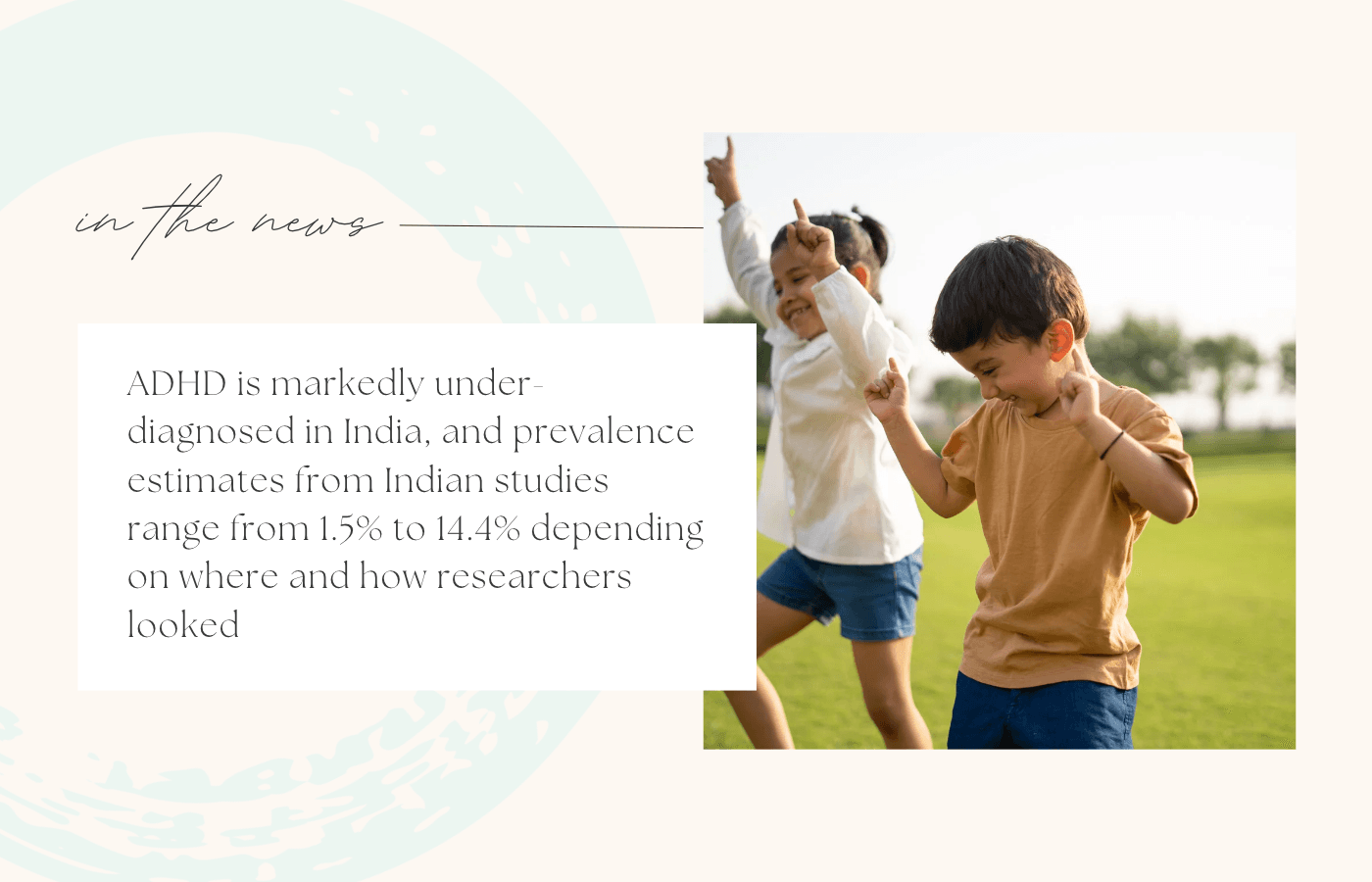
ADHD is markedly under-diagnosed in India, and prevalence estimates from Indian studies range from 1.5% to 14.4% depending on where and how researchers looked, according to the review. It recommends recognizing the condition under the Rights of Persons with Disabilities Act, 2016, which does not currently list it.

The authors are Althaf Mahin, Bristow Ben Joseph, Fathimathul Sunaina, Fathimathu Rasana and Rajesh Raju of the Center for Integrative Omics Data Science at Yenepoya (Deemed to be University), Mangalore. Mahin and Raju are the corresponding authors. The paper is a narrative review drawing together Indian epidemiological studies, diagnostic practice, treatment access, and policy.

Prevalence estimates range tenfold across states

The review collects the following figures from Indian studies.

Location

Population studied

Prevalence

Konkan, Maharashtra

School children

1.5%

Belagavi, Karnataka

Primary schools

5.76%

Kottayam, Kerala

Preschoolers

6%

Rural Jammu and Kashmir

School children

6.34%

Kerala, 73 schools

Adolescents, self-report

7.52%

Kancheepuram, Tamil Nadu

3,253 students

8.8%

Coimbatore, Tamil Nadu

770 students

11.32%

Cachar, Assam

School children

12.66%

Delhi

Adults aged 18 to 25, ASRS screen

14%

Mysore, Karnataka

1,145 students

14.4%

Pathanamthitta, Kerala

Tertiary hospital outpatients

22.9%

For global comparison, the authors cite prevalence of 7.6% in children aged 3 to 12 and 5.6% in adolescents aged 12 to 18 (Salari et al., 2023).

The authors state that the Indian estimates vary widely because of differences in study design, screening instruments and access to care.

Diagnosis concentrated in metropolitan centers

The review reports pervasive gaps in awareness, delayed identification and limited access to specialized interventions. Specialist services are concentrated in metropolitan centers, while rural areas and smaller urban areas have limited access.

In rural communities, the authors write, ADHD symptoms are often interpreted as indiscipline, poor upbringing or a lack of motivation, and some traditional beliefs attribute them to spiritual or moral causes. The review notes that culturally adapted assessment tools have been developed in India, including the INDT-ADHD associated with AIIMS, and that the ECHO-ADHD program aims to close service gaps through training and tele-mentoring.

Girls and women under-recognized

Boys in India are approximately twice as likely as girls to receive an ADHD diagnosis, according to the review. It attributes the gap in part to presentation: female symptoms tend to be internalizing, including low self-esteem, affective disturbance and inattention, rather than hyperactivity.

The authors cite a study of 101 treatment-seeking Indian adults with ADHD, of whom 78 were men and 23 were women. They name female ADHD as a priority research area.

Methylphenidate is the primary medication

Methylphenidate is the primary ADHD medication in India, the review states. Atomoxetine and clonidine are used where stimulants are contraindicated or poorly tolerated, or where anxiety or tic disorders are present.

Barriers to treatment include cost, regulatory requirements, shortages of specialists particularly in rural areas, adherence concerns, stigma, and limited awareness among caregivers and teachers. Behavioral therapy, parent training and school-based support are described as inconsistently available, while use of CBT is growing for adolescents and adults. Evidence for complementary approaches, including Ayurveda, yoga, and meditation, is described as limited.

Comorbidity and environmental factors

In clinical cases, the review reports externalizing disorders such as oppositional defiant disorder and conduct disorder in 20% to 50%, learning disorders in 20% to 40%, and anxiety and depression in substantial minorities.

COVID-19 lockdowns were associated with worsened symptoms and with disruption to treatment and help-seeking.

What the authors recommend

  1. Recognize ADHD under the Rights of Persons with Disabilities Act, 2016, to support early screening, teacher training and integration into primary care.

  2. Strengthen epidemiological surveillance.

  3. Expand equitable access, including telepsychiatry, family education and rural service models.

  4. Fund longitudinal cohort studies, implementation research, and research on female and adult ADHD.

The authors state three limitations of their own review. The evidence is heterogeneous across regions and methods, rural populations, women, and adults are underrepresented in it, and much of the environmental evidence is contextual rather than causal.

The Schedule to the Rights of Persons with Disabilities Act, 2016 lists 21 specified disabilities, including autism spectrum disorder and specific learning disabilities. ADHD is not separately enumerated. Benchmark disability, the 40% threshold that governs entitlements such as the 5% reservation of higher education seats under Section 32, applies to a specified disability, so families seeking certification for ADHD are generally assessed under the learning disability or neurological categories.

School examination boards differ. CISCE states that candidates with dyslexia, dysgraphia, dyscalculia and ADHD are admissible for concessions on a case-by-case basis. The CBSE circular consolidating exemptions and concessions for Classes X and XII is framed around benchmark disability categories and does not name ADHD.

On workforce, the Press Information Bureau cites Indian Journal of Psychiatry figures of 0.75 psychiatrists per 100,000 people in India, against a WHO recommendation of at least three, and estimates that 70% to 92% of people with mental disorders do not receive treatment.

On medication supply, methylphenidate is controlled under Schedule X of the Drugs and Cosmetics Rules and the NDPS framework, while atomoxetine is dispensed under the ordinary Schedule H regime, a difference practitioners link to uneven pharmacy stocking of the stimulant. Amphetamines and lisdexamfetamine are not marketed or approved in India.

On assessment, public sector evaluation is free or low cost, with waiting lists at major institutions typically measured in months. Private assessment in metros ranges from around ₹1,500 for a psychiatrist consultation with rating scales to ₹20,000, which includes comprehensive psychometric testing. Diagnosis is clinical and requires a developmental history.


Talk to someone

Talk to a therapist who understands ADHD.

Our founders personally interview every therapist in our directory.

Fees shown upfront50-minute online sessions
Find a therapist

Want to keep reading? Get our anthology, Our Stories Are Us

The MyndStories Collection

Our physical imprint on the digital landscape. Curated for the slow, thoughtful reader.

View All Products
Our Stories Are Us — MyndStories Anthology
Our Anthology

Our Stories Are Us

23 Indians share their mental health journeys in essays that heal. Bound in a book that matters.

Order Your Copy
MyndReaders

Book Club

Expand your horizons with monthly curations of literature that challenges and heals. Join a community that reads with intention.

Join the Book Club
Book Club Selection 1
Book Club Selection 2

Continue the Journey

ADHD · 7 MIN READ

Worn soft at the elbows

Sumit Singla writes on inattentive ADHD diagnosed at 45, the pressure of unfinished tasks, and learning that wear can soften rather than ruin you.

Weekly Curations

Join 15,000+ readers who receive our Sunday morning editorial on mental health, literature, and living well.

We value your peace. No spam, just stories.