
As a first-person essay, this does not require review by our team of Reviewers. Barring minor changes for grammar and sentence structure, we have kept the voice of the author intact.
The news of Charlie’s passing is the first thing I see in the morning and tears gather at the edge of my eyes. Simultaneously, a question pops up. "Should I double tap and ‘like’ this post?" when there is nothing in it worth liking. I would rather dislike it. I despise this news. Charlie, the beloved Indie of Bangalore-based illustrator, Alicia D Souza, reminds me what grief feels like once again.
Grief, they say, is for those you know, someone close to you, someone you’ve met. Charlie wasn’t. He was a dog on the internet. I never met him, petted him, or called out to him to see his ears pop up.
Yet, somehow his loss now feels like losing a pet all over again. Having been a companion to seven dogs, I know what losing a furbuddy at home feels like.
Growing up as a single child, I often introduced my dogs as my siblings with four legs, accompanying me through every growth phase. So, when I started following Souza for her illustrations and documentation of Charlie, her portrayal of unapologetic love was relatable. Her ‘goodest boy in the world’ became my virtual dose of checking up on a pet.
As someone who has lived with pets, I formed a parasocial connection with Charlie very naturally. I looked forward specifically to all of his updates. I remember following Alicia Souza for her cute illustrations but it was Charlie’s updates that made me continue to stick with her through the years. I watched stories of his adoption, how he looked like a normal Indie puppy, before growing so much fur that made him squishable. His photos wearing a Christmas cap, bowties and wigs, his crescent moon eyes that felt talkative. It has been a month since Charlie passed and somehow these memories still come vividly to me.
I never felt the weight of his head on my lap, but I loved watching him getting scritches from his parents. I loved watching his black wet snout - perfect for a virtual boop. I loved how he just preferred his own space. He wasn’t an overtly friendly dog; he had boundaries, dignified ones, that would only be crossed if someone came bearing treats.
I know this in detail because I observed Charlie and his quirks through the phone screen every single day. For seven years, I was following his journey, photos of him dressed in a Christmas hat, his likes and dislikes, royal ignorance for the community cat and more. The recent posts did seem heavier, his age catching up, his bouts of illnesses, his owner’s panic in the middle of the night. She was preparing herself, and without meaning to, her followers too. I read them like a distant friend and hoped, not yet, please not yet.
Until it was.
The post of his photo with the dates of his birth and death. Before reading a single word, I went still. A shiver ran through my body, a montage of his memories rushed through my mind. Unanswered questions popping up one after another: what must have happened? Were his parents close to him? What does the house look and smell like now? What happens to his square bed? His toys? Quilt? Treats? I stared at Charlie’s photos, his walk stories, his condescending ignorance for the community cat, all flashing in my eyes.
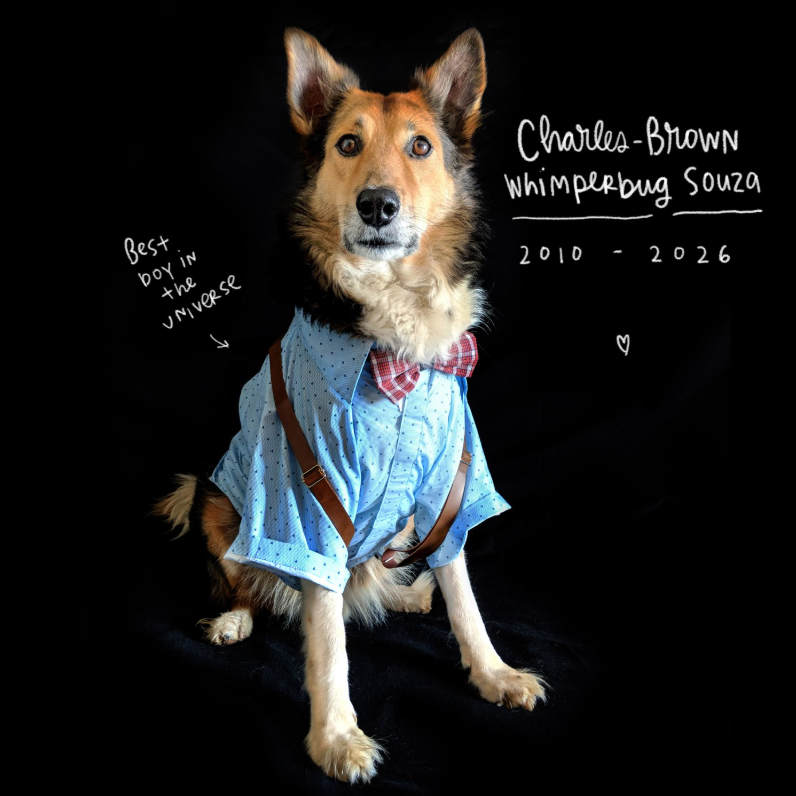
Somewhere in that montage, I think, I also saw my own dog looking at me. Grief once again, like an uninvited guest, arrived.
Throughout the days that followed, I looked forward to knowing more about Charlie’s passing, not realizing that this grief belonged first to Souza and her family. And her detailed grief notes made me cry once again. The comments and love pouring in showed she wasn’t alone.
Grief doesn’t need proximity or labels. Hers, mine, theirs, ours? How do we label and decide who and how much to feel this deep loss for? Let this feeling be a collective thing we feel for a soul that changed our lives, even without realizing it did.
We humans do it all the time. We grieve for strangers in the news, we feel angry at the writers of a TV show when our favourite character dies, we shed tears when a singer from the band we grew up listening to passes away. We grieve for the places we loved before they changed forever, and we also grieve for the apathy that is yet to find us.
Every bout of this sadness does not have to match the relationship of how well you knew someone or something. Grief doesn’t even appear in a single form; it’s an emotional response. It can come in strong waves or feel slow like sand slipping with the wind, particle by particle.
What you feel for someone (and what I feel for Charlie, even as I type this) is a sign of us being empathetic humans. In my case, I will reflect on Charlie’s death and his family’s grief, which reminds me of my own feelings of losing my pets. It could be my familiarity with a sombre situation that makes me miss Charlie.
The best response, I realize, is to give yourself the space to feel it all. To acknowledge that we do have the ability to be so deeply connected to someone, despite never meeting them. We value the memories we were, at most, an audience to.
And maybe I am grieving the living proof that somewhere a dog was so loved and pampered, that the internet joined along to care and to share that he and his family, although unknown to most of us personally, are never alone.


